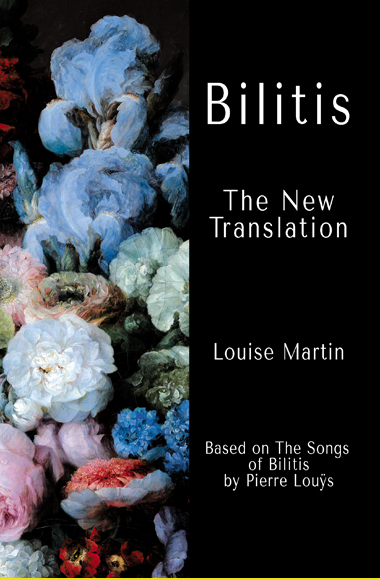
by Louise Martin
In 1894, Pierre Louÿs unveiled Les Chansons de Bilitis to the French literary world, presenting it as a newly discovered translation of ancient Greek poetry composed by a contemporary of Sappho. The scholarly apparatus was elaborate, the archaeological provenance convincing, and the deception complete. It was also one of the most erotic, tender, and surprisingly resonant celebrations of lesbian desire in Western literature.
When the hoax was exposed, it might have consigned Bilitis to a footnote in literary history. Instead, something remarkable happened. Generations of lesbian and queer women claimed the text as their own, reading themselves into its lines, finding in its imagery of women loving women a mirror that official literature refused to provide. Natalie Barney and Renée Vivien celebrated Bilitis in the lesbian salons of Paris. In 1955, Del Martin and Phyllis Lyon named the first American lesbian civil rights organization the Daughters of Bilitis, repurposing a man’s fantasy into a vehicle for self-determination. The text that Louÿs wrote for the male gaze became, through generations of radical reading, something he never intended: a cornerstone of queer cultural identity.
This new edition brings Les Chansons de Bilitis into the twenty-first century with a fresh English translation alongside a lesbian feminist reading of the text. Translator and scholar Louise Martin approaches the poems as palimpsests — texts where new meanings can be inscribed over the original without erasing what came before. The result is a dual encounter with Bilitis: first as Louÿs wrote her, in all the complexity and contradiction of a male author ventriloquizing female same-sex desire, and then as lesbian radical reading reveals her, a figure of autonomy, pleasure, and resistance.
The collection follows Bilitis across three phases of her life. In Pamphylia, she is a girl discovering desire among other girls, her awakening sexuality woven into the natural world around her. In Mytilene, she finds in Mnasidika a love that is complete and fulfilling on its own terms, a relationship the poems present not as a phase or a substitute but as the full experience of erotic and emotional life. In Cyprus, she navigates the more complex terrain of a world that will not leave women to love as they choose.
The accompanying essays situate the poems within both their historical moment and their remarkable afterlife. Louÿs wrote from within a patriarchal and Orientalist tradition, projecting European sexual fantasy onto an imagined ancient world. That context cannot be ignored, and this edition does not ignore it. But neither does it stop there. The lesbian feminist reading that runs alongside the translation asks what happens when we refuse the author’s intention as the final word, when we read not for what Louÿs meant but for what the text makes possible. The answer, as generations of queer readers have already demonstrated, is more than anyone might have expected from a nineteenth century literary hoax.
This edition also includes original poems by Louise Martin, composed to fill gaps in the narrative where Louÿs indicated untranslated material in the original French editions. These new poems, clearly marked as Imagined Fragments, maintain the voice and thematic progression of the collection while extending Bilitis’s story in directions Louÿs left open.
Bilitis: A New Interpretation is a book for readers who understand that literature belongs not only to those who write it but to those who read it, claim it, and transform it. It is for anyone who has ever found themselves in a text that was not written for them, and refused to leave.
- Thrift Books
- Amazon USA
- Amazon Canada
- Amazon UK
- Barnes & Noble
- Kobo
- Find Bilitis: The New Translation at your favorite bookstore or online retailer. Click here to search worldwide!
Bilitis: The New Translation – Excerpt
TRANSLATOR’S NOTE
This translation is based primarily on the 1901 definitive French edition (Bibliothèque-Charpentier) and the Project Gutenberg French text. The structural arrangement has been verified against Bessie’s 1926 translation and the 1951 Shakespeare House collection.
Where poems are marked as “(non traduite)” in the French editions, I have created both French and English versions of these missing poems. These original compositions, marked as “Imagined Fragment” in the text, attempt to maintain Louÿs’s style and thematic progression while filling narrative gaps he left in the sequence.
LOUISE MARTIN
May, 2026
THE BED (Imagined Fragment)
The bed is low and wide, covered with white sheets and soft furs. The plump pillows await our heads, and the wooden frame creaks gently.
An oil lamp burns in a corner, casting trembling shadows on the walls. The air is perfumed with myrtle and rose, like the gardens of Aphrodite.
Mnasidika stretches out there, naked as a goddess, her hair unbound upon her shoulders. Her arms call to me and her eyes shine in the half-light like stars.
I approach her in silence, my heart pounding. Her skin against mine is softer than the almond blossom, and burning like sand beneath the midday sun. Our sighs mingle like prayers to the immortals.
LE LIT
Le lit est bas et large, couvert de draps blancs et de peaux douces. Les oreillers gonflés attendent nos têtes, et le bois du cadre craque doucement.
Une lampe d’huile brûle dans un coin, jetant des ombres tremblantes sur les murs. L’air est parfumé de myrte et de rose, comme les jardins d’Aphrodite.
Mnasidika s’y étend, nue comme une déesse, ses cheveux dénoués sur ses épaules. Ses bras m’appellent et ses yeux brillent dans la pénombre comme des étoiles.
Je m’approche d’elle en silence, le cœur battant. Sa peau contre la mienne est plus douce que la fleur de l’amandier, et brûlante comme le sable sous le soleil de midi. Nos soupirs se mêlent comme des prières aux immortels.